Scams Targeting Translators: Fake Agencies, Free Tests and Other Tricks
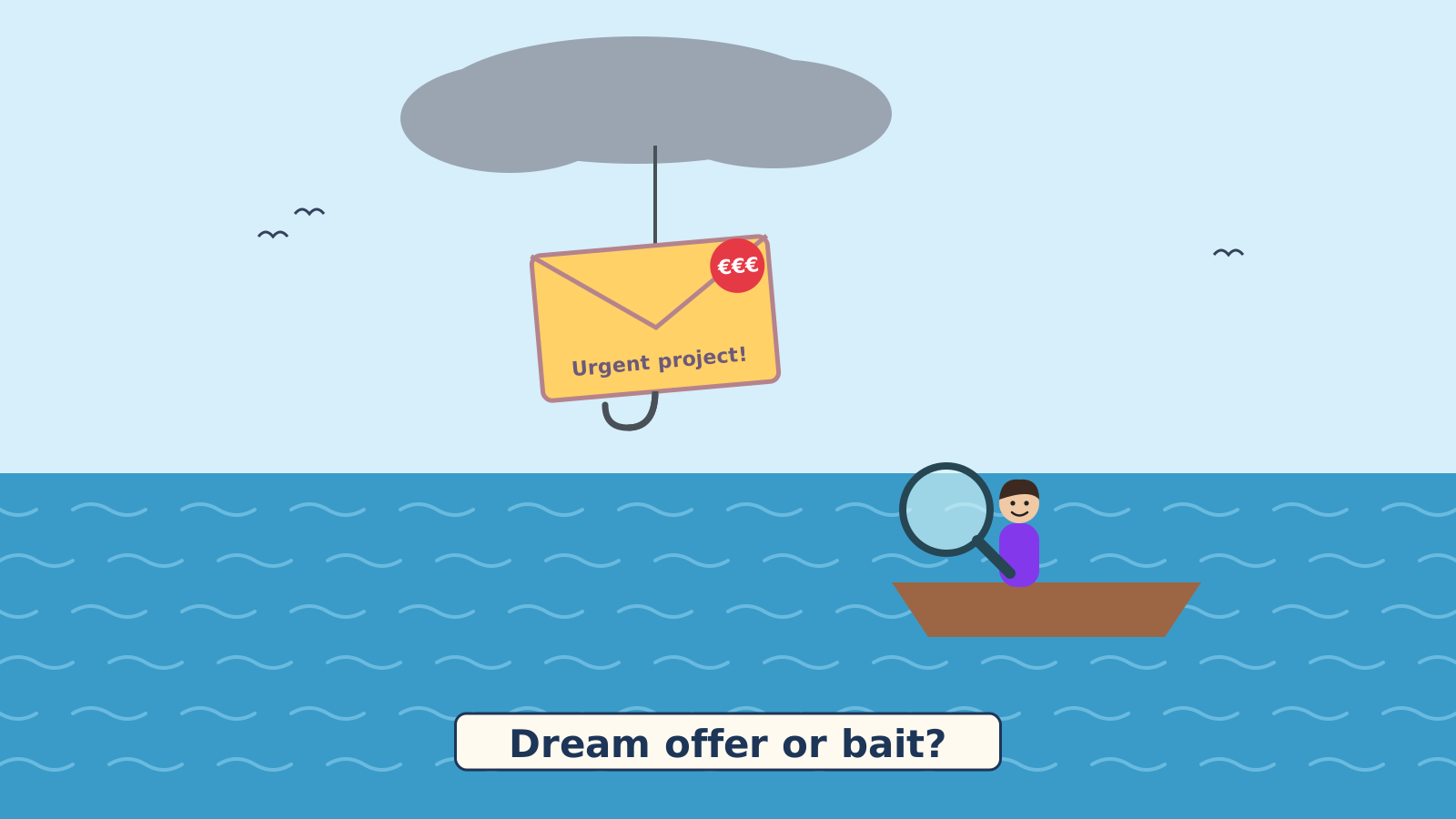
Scams targeting translators are no longer clumsy emails full of spelling mistakes. Today they arrive with the logo of a well-known translation agency, the signature of a project manager who really exists, a flawless non-disclosure agreement and a purchase order with a reference number. The job is long, urgent and well paid. And once you deliver, either the money never arrives or you are asked to pay to “release” it. In this article we explain how these schemes work, which other traps circulate in the industry (free tests that are really paid jobs in disguise, cheques that overpay, stolen CVs) and which precautions will save you money and stress.
This guide comes from Traductores Nativos, a search engine where clients find a native translator and write to them directly, with no middlemen inflating the price. Every translator has their own profile page, client reviews are public and payment can go through a guarantee service. That is why we care that translators can tell a real client from an impostor.
Video: six traps worth recognising in time
Short on time? This narrated video sums up the most common scams against translators and the signs that should make you stop.
The email that seems to come from a well-known agency
This is the fastest-growing variant. Scammers pick a real translation agency with a good reputation, copy its name, its logo and often the name of someone who works there, and write to freelance translators offering a project. Several cases following the same script have been documented in the ProZ.com scam forum, and below we describe three of them by name.
It is no coincidence: in a market changing as quickly as the one we described in the translation industry in 2026, many freelancers accept projects from agencies they have never worked with. The typical scheme has these steps:
- A flattering first contact. “We found your profile and love your experience.” That line proves nothing: scammers copy it from genuine platform messages.
- A big, urgent project. Thousands of words (almost 18,000 words of academic legal text in one reported case), a tight deadline and an attractive rate.
- Professional-looking paperwork. A non-disclosure agreement and a numbered purchase order that create an air of seriousness.
- A change of channel. The conversation quickly moves to WhatsApp or a Gmail address, with phone numbers that keep changing.
- The ending. After delivery, “the client has approved the work” and you are handed to a so-called finance department that demands a fee for a “supplier card” or to “release the payment”. In other cases they simply vanish with your translation and resell it to a real client.
Some variants also use the names and photos of real translators to make the message credible. Seeing a colleague’s name does not mean they are involved: they are usually another victim.
Real cases: three impersonated agencies
So that you know what they look like, here are three cases documented in the ProZ.com scam forum. In every one of them the agency is the victim of the impersonation, not the author of the fraud:
- AA Global (2026). Supposed project managers called “Maverick Rowann” and “Alistair Wren” offered a project of about 17,800 words from English into Brazilian Portuguese, with a non-disclosure agreement and a purchase order numbered AGG-PO-2026-0423. The conversation continued on WhatsApp and Gmail; after delivery, a “finance manager” with a Canadian number asked the translator to pay for a “Freelancer ID Card” to release the payment (in a similar case involving a Polish job, the fee was 112 pounds). The quality and compliance manager of the genuine AA Global confirmed that nobody with those names works there and that the company does not run projects over WhatsApp.
- Wordminds. The scammers wrote from a Gmail account bearing the agency’s name (“wordminds.translations”) and a company manager’s signature, offered jobs of more than 10,000 words and asked for bank details and a postal address to send a bank cheque in advance. Wordminds stated in the forum that it never uses Gmail accounts and that all its projects come from corporate email addresses. One translator reported losing more than 500 euros between this case and a similar one.
- Flynde Translation Solutions. Impostors posed as this company from Gmail addresses, offered unusually high rates and used the names and photos of real translators without their permission. One of the impersonated translators confirmed having no connection whatsoever with the messages.
The agency names change from month to month, so memorising this list is not enough: what repeats is the pattern.
How to check in five minutes whether the email is genuine
- Read the domain letter by letter. A serious agency writes from its corporate domain. Be wary of Gmail, Outlook or near-identical domains (an extra or missing hyphen, a swapped letter, a different extension).
- Do not reply to the email to verify it. Look up the agency’s official website yourself, open its contact page and ask from there whether that person and that project exist.
- Be suspicious of the jump to messaging apps. Many agencies manage projects through their own portal or corporate email. If they insist on WhatsApp from the first minute, treat it as a red flag.
- Check the purchase order. Make sure the company details, address and signatory match what the company publishes.
- Ask for a short video call. A real project manager will usually agree without fuss; an impostor will look for excuses.

The translation test that is really a job
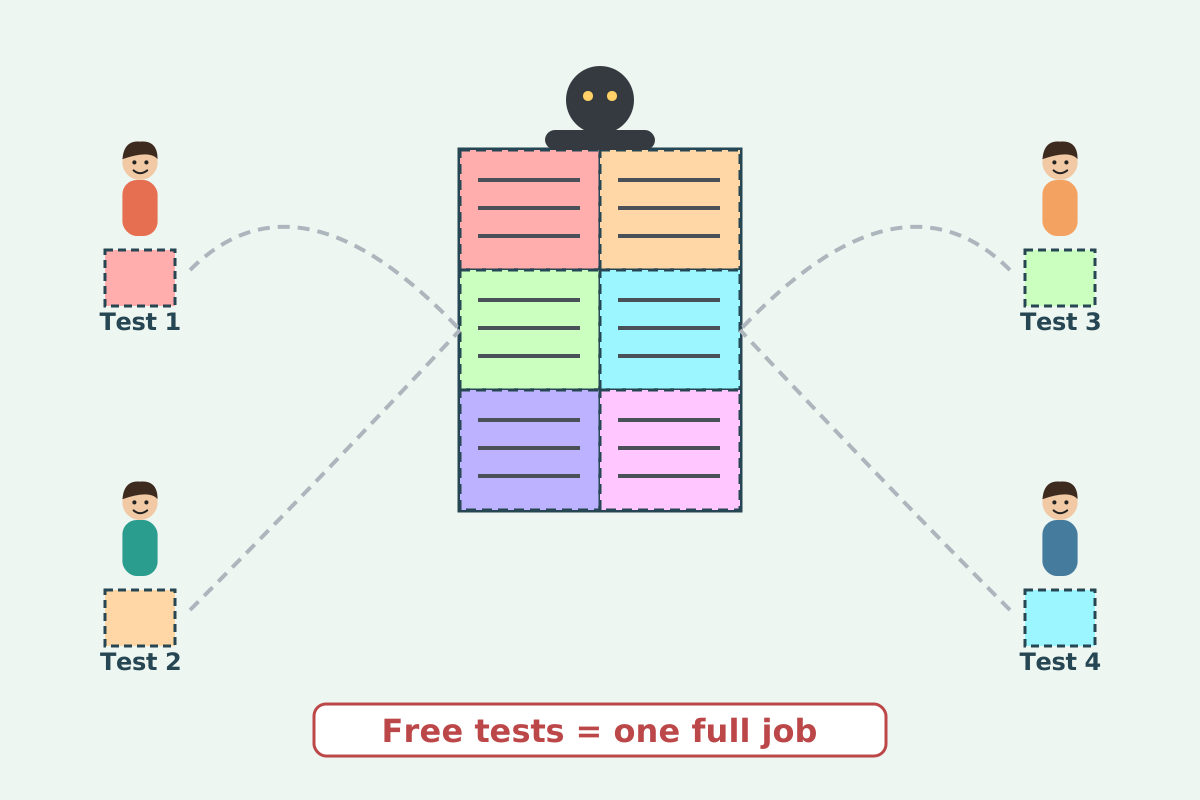
Translation tests are a legitimate practice: many agencies assess new collaborators with a short text. The problem starts when the “test” is actually a piece of a real assignment. The company cuts a document into fragments, sends each one as a free test to a different translator, puts the pieces together and delivers the result to its client without paying anyone. A similar variant: an experienced professional does the test and the project ends up with someone cheaper.
Signs that a test may be a disguised job:
- It is long. In the translator community a free test of 100 to 300 words is usually considered reasonable; anything beyond that is sensibly treated as paid work.
- The text starts and ends mid-sentence or looks torn from the middle of a document, with no context.
- The deadline is very short, as if a client were waiting.
- The sender is unknown and has no verifiable track record.
- Nobody tells you who will assess the test, by which criteria or when you will hear back.
What to do: before starting, ask about the length, deadline, assessment criteria and whether you will receive feedback. Offer a sample of earlier work (with the client’s permission or based on a public text) or propose translating the fragment as a paid job at a reduced rate. And if you do a test, keep a dated copy: if you later find your text published, you will be able to prove it.
The cheque that pays too much
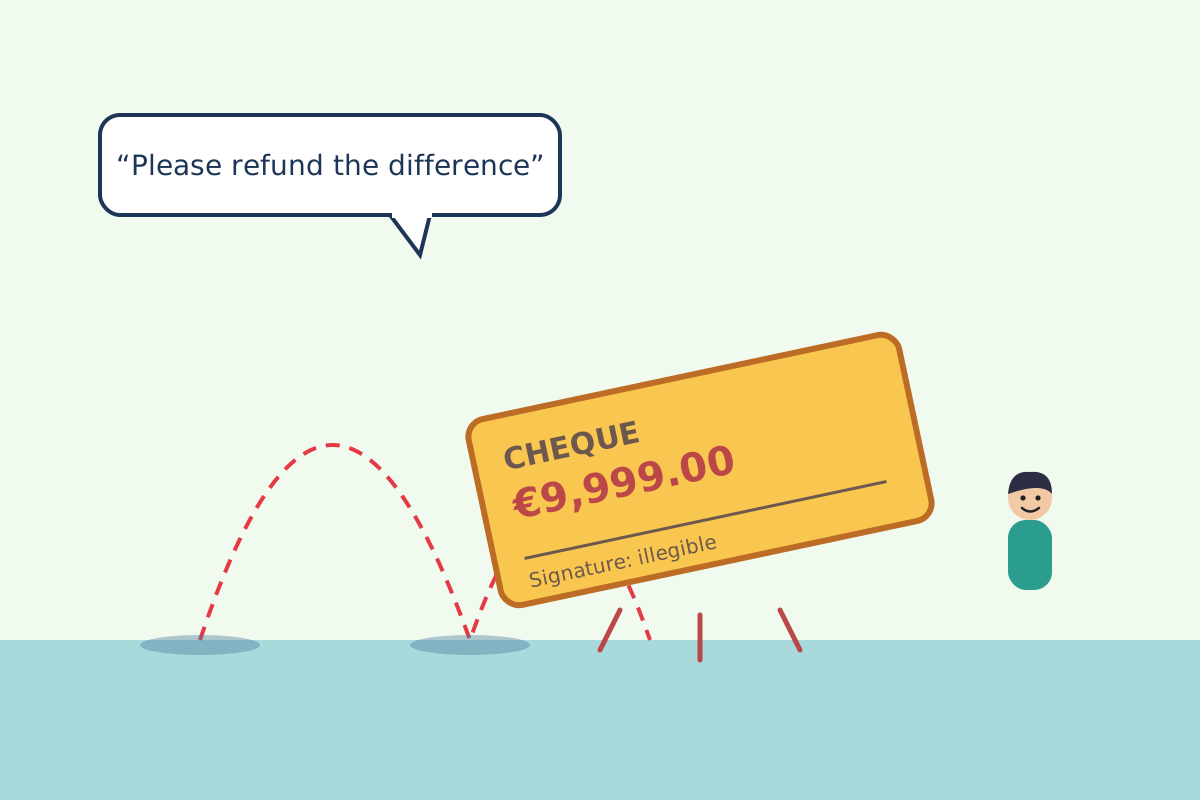
A classic that still works. A new client orders a large project and offers to pay in advance by bank cheque or transfer. Soon afterwards they tell you that, “by mistake”, they have paid too much, or that part of the money belongs to a third party (a designer, a “software provider”), and ask you to return or forward the difference. Days later the cheque turns out to be fake or the payment is reversed, and the money you sent does not come back.
Of all the scams targeting translators, this is the one that can cost you your own money, because you lose more than your work. The rules are simple: do not start working until the payment is definitively available in your account (fake cheques can take days or weeks to bounce), never return an “excess” and never let your account be used to move other people’s money. Besides being a scam, the latter can get you into trouble with your bank over money laundering.
Paying to work: cards, certificates and compulsory software
Another family of scams turns the relationship upside down: the “client” asks you for money. It might be a fee to register as a supplier, a supposed translator certificate or ID card, membership of an invented association or the compulsory purchase of translation software, often paid into a personal account. The golden rule repeated by industry guides is clear: never pay a company to hire you. Real agencies may ask you to use a particular tool, but they do not sell you the licence or charge you to “activate” your profile.
Your name working for someone else: CV theft
Sometimes it is not you who gets scammed but your reputation. Identity thieves copy a real translator’s CV, replace the email and phone number with their own and send it to agencies. If they land a job, they handle it with machine translation or by subcontracting someone badly paid, and get paid in your name. The Translator Scammers Directory, a volunteer group that has documented these cases for years, had more than 5,900 fake CVs and more than 21,000 scammer email addresses in its database in 2022, according to Slator.
How to protect yourself: publish your CV in a non-editable format with a watermark or a link to your professional profile; always use the same contact address and state it everywhere; search for your name online from time to time; and if an agency contacts you about work you never did, warn them that someone may be impersonating you.
The client who disappears after delivery
Not all scams targeting translators are sophisticated. Many simply consist of not paying: a client with no history orders a translation, receives it and stops answering. To reduce the risk, ask for full company details before starting, send a quote with written payment terms, request an advance on large jobs or from new clients, split long projects into deliveries invoiced separately and check the feedback other professionals have left about that client on industry platforms and forums.
Links, attachments and fake login pages
A job offer is perfect bait for phishing: “download the source document here”, “log in to our supplier portal”. The link leads to a page that imitates the login of your email, a translator platform or a payment service and captures your credentials. Other messages contain password-protected compressed attachments hiding malware. Do not open unexpected attachments, reach platforms by typing the address into your browser yourself and turn on two-step verification for your email and payment accounts.
Checklist before accepting a job from someone new
- Does the sender write from a corporate domain that matches the official website?
- Have I verified it through a channel I found myself, not the one they gave me?
- Are the rate and volume reasonable for my language pair and specialisation?
- Do I have the price, deadline and payment terms in writing?
- Are they asking me for money, my passwords or to forward payments? If so, I stop.
- If it is a test, is it short, does it make sense on its own and do I know how it will be assessed?
- Are there reviews by other professionals or clients about this company?
If you are building a client base of your own, our series of guides has ideas by language pair, for example where to look for clients as a Spanish to English translator.
If you have already been caught: what to do now
- Cut off contact and do not send any more money, not even to “recover” what you lost: follow-up scams by fake recovery services are common.
- Keep the evidence: emails with their headers, WhatsApp screenshots, phone numbers, purchase orders and payment receipts.
- Call your bank as soon as possible if you made a transfer or shared payment details.
- Warn the impersonated agency through its official website: you will help it alert other colleagues.
- Change your passwords and turn on two-step verification if you clicked a link.
- Report it to the police or your country’s fraud-reporting service (in the United States, for example, the FTC at reportfraud.ftc.gov). If the contact came through a platform, tell its support team as well; ProZ.com, for example, keeps a guide to fake job offers and a scam alert forum.
Direct clients and clear rules: your profile on Traductores Nativos
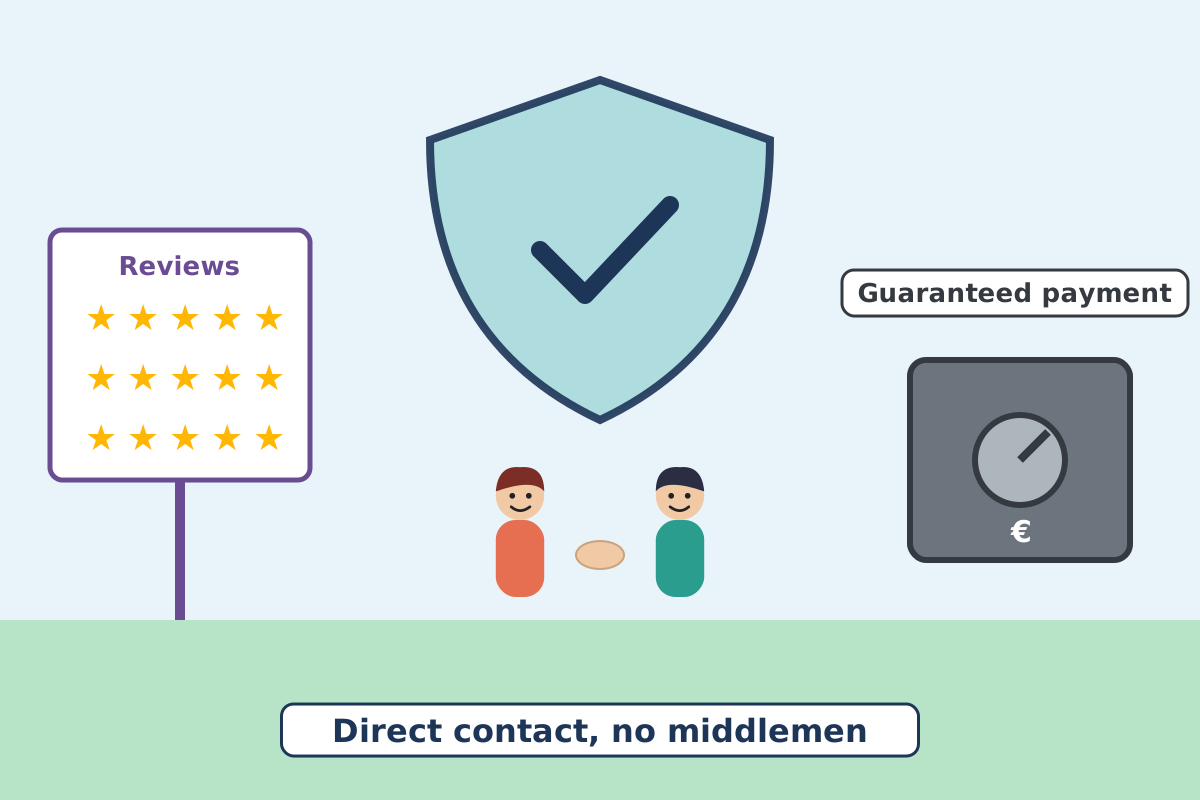
Many scams targeting translators rely on the same weakness: you don’t know who is really on the other side, and you agree to work blind for an intermediary who claims to speak for someone else. On Traductores Nativos the relationship works the other way round. The client finds you on your profile page and writes to you directly; you talk to the person or company who needs the translation, without subcontracting chains. Client reviews are public, so your reputation is built in plain sight, and payment can go through a guarantee service.
A few tips to make the most of it:
- State your terms on your profile: how you quote, when you ask for an advance and how quickly you reply. Clear rules discourage anyone acting in bad faith.
- Explain which kind of tests you accept (for example, short samples) so you don’t waste time on 2,000-word “tests”.
- Ask every satisfied client for a review: it is your best credential against impostors using other people’s names.
Want to create your profile? Write to us via https://traductoresnativos.com/contactar/ or at info@traductoresnativos.com.
Frequently asked questions about scams targeting translators
A well-known agency writes to me from Gmail. Is it always a scam?
Not always, but it is reason enough to verify. Find the agency’s official website and confirm through its contact page that the person works there and that the project exists. Several impersonated agencies have stated publicly that they only use their corporate email.
Should I refuse every free test?
Not necessarily. A short test that makes sense on its own and has clear assessment criteria is common practice. The sensible approach is to limit the length, ask about the conditions before starting and treat anything beyond that as paid work.
My name was used in a fraudulent email. What should I do?
Warn the agency that received the message, state on your professional profiles which address is your only contact address and keep the evidence in case you need to report the impersonation.
Is replying to scammers to waste their time a good idea?
Better not. Replying confirms that your address is active and may bring you even more attempts. Block, report and get on with your work.
Conclusion
Scams targeting translators change their costume, but they repeat the same ingredients: urgency, easy money, improvised channels and someone asking you to pay or to work for free. Verify on your own, limit tests, never return an excess, never pay to work and favour direct relationships with clients whose identity and reputation you can check. A few minutes of checking are worth more than a week translating for nobody.
Related articles
About the author: Viorel Tiple is the founder of Traductores Nativos, a search engine that puts clients in direct touch with native translators, with no middlemen.