Where to Look for Clients if You Are a Freelance Ukrainian to English Translator
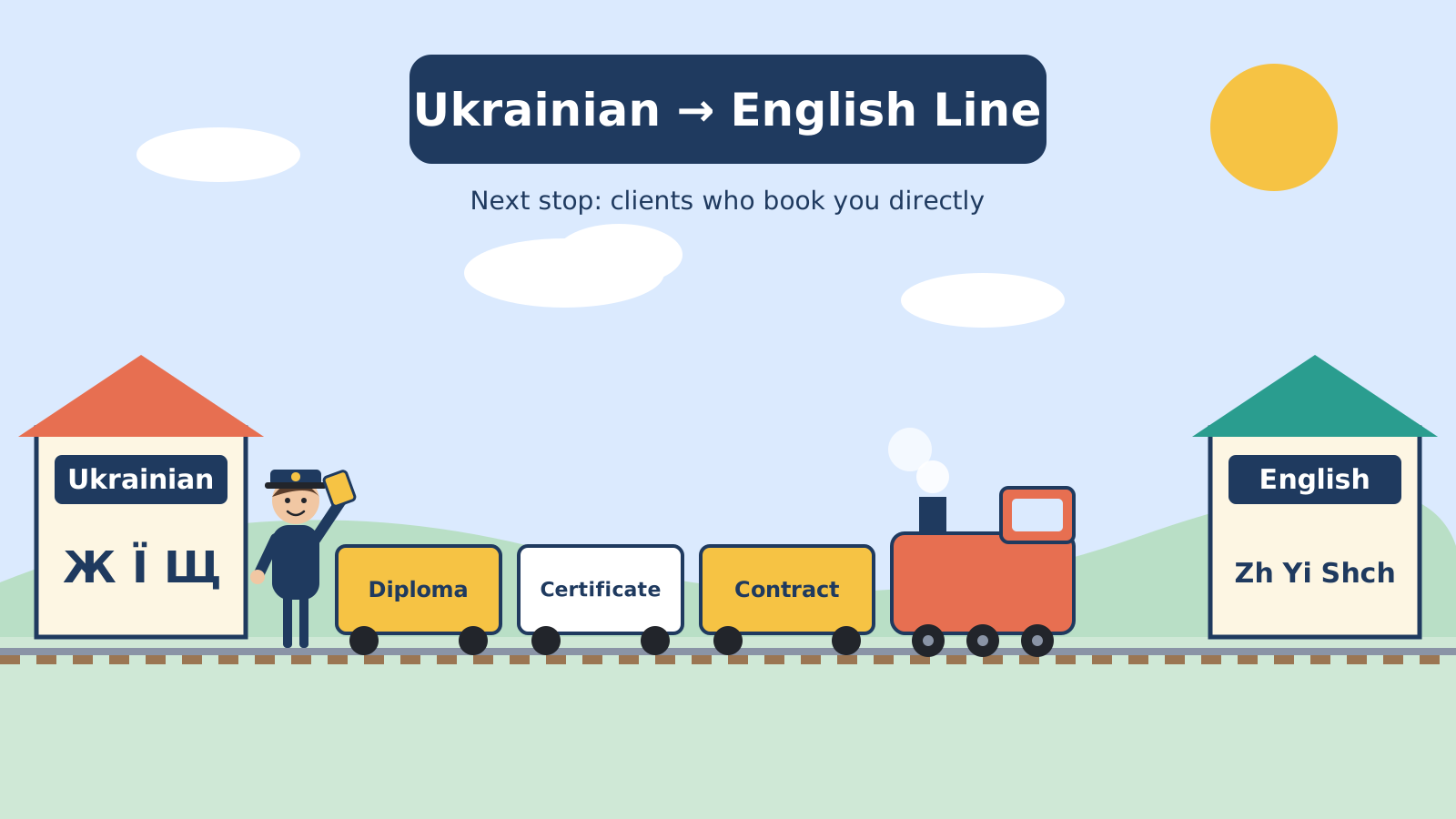
As a freelance Ukrainian to English translator, you work in a direction whose demand changed shape almost overnight. Before 2022 the typical client was an exporter, a researcher or a couple getting married abroad. Today hundreds of thousands of Ukrainians live in English-speaking countries or deal with English-speaking authorities, and every residence application, school enrolment and job offer starts with a document written in Ukrainian. This guide treats the market as a railway line: each platform is a different kind of passenger who needs your services, and each one boards in a different place.
A note on the source of this guide: it comes from Traductores Nativos, a translator search engine. Clients use it to pick a native translator and message that person straight away, so no agency sits in the middle inflating the price. Each translator keeps their own profile page, earlier clients leave reviews that anyone can read, and a guarantee service is available for payments. So this guide concentrates on the clients who pick their translator personally, not on long subcontracting chains.
Video: eight stops on the Ukrainian to English line
Prefer to listen? This narrated summary covers each platform, the transliteration puzzle and the shortest way to clients who contact you directly.
Before the train leaves: what makes this direction unusual
Three things set Ukrainian into English apart from most pairs that end in English.
First, the passengers are scattered. The source texts come from Ukraine, but the clients are often far away from it: in Manchester, Dublin, Toronto, Chicago, Melbourne, or in a Polish or German town where a family needs an English version for an employer. Your marketing therefore has to work in several countries at once, and often in Ukrainian rather than English, because the person paying is Ukrainian.
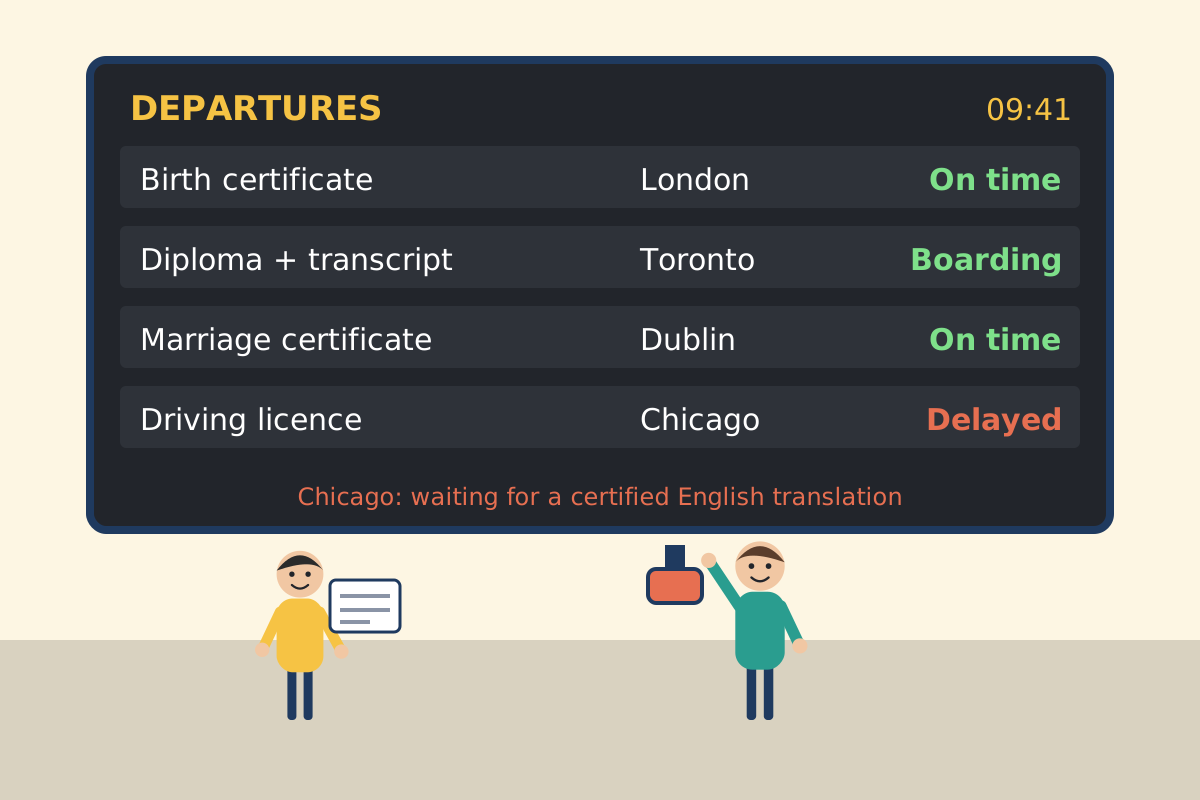
Second, the volume is dominated by personal documents. Birth and marriage certificates, school-leaving certificates, university diplomas with their supplements, driving licences, medical summaries and employment records make up a large share of the work. Each job is small, but the flow is steady and the clients come back with relatives.
Third, many of the documents you receive are not really in one language. A grandmother’s birth certificate from the 1970s may be in Russian, a 1990s certificate may be bilingual, and a recent extract may be a screenshot from the Diia state app. Being clear about what you accept, and what you do not, saves a lot of awkward conversations later.
Platform 1: families building a life in English
This is the busiest platform. Ukrainians who arrived in English-speaking countries under humanitarian schemes are now moving from emergency arrangements to longer-term plans: extending permission to stay, enrolling children in schools, getting qualifications recognised, renting flats, opening bank accounts and, in time, applying for other types of residence. Each step needs English translations of Ukrainian papers.
The rules are set by the receiving country, not by Ukraine, so a good freelance Ukrainian to English translator knows the main destinations by heart.
United Kingdom
The UK has no sworn translators. For immigration applications, the Home Office looks for a translation that states it is accurate, carries the date, the translator’s full name and signature, contact details and, for applications made inside the UK, the translator’s credentials. Ukrainian families in the UK have also seen their stay prolonged: in spring 2026 the government announced a further 24 months under the Ukraine Permission Extension scheme, so demand for documents tied to longer stays has not disappeared. Membership of the Institute of Translation and Interpreting or the Chartered Institute of Linguists is the quickest way to answer the “credentials” question.
Ireland and the rest of the EU
Ireland applies the EU’s temporary protection for people displaced from Ukraine, which the Council has extended until March 2027. Irish employers, universities and professional bodies may ask for English translations, and so may employers in other EU countries where English is the working language of the company. In those cases, ask the client exactly which body will read the translation and what form of certification it wants.
Canada
Canada is home to one of the largest Ukrainian diasporas in the world and has the strictest rulebook of the four. Immigration, Refugees and Citizenship Canada wants a translator who is a member in good standing of a professional association, shown by a stamp with a membership number; otherwise the translation needs an affidavit sworn before a notary public or commissioner of oaths. Relatives of the applicant may not translate at all, and that includes cousins who happen to be translators.
United States and Australia
For US immigration paperwork, USCIS expects a complete English translation accompanied by the translator’s certification that they are competent in both languages and that the translation is complete and accurate. Australia relies on credentials from NAATI; if you live there, check which Ukrainian credentials are currently offered before you promise a client an “official” translation.
Platform 2: paperwork that stays behind in Ukraine
Not every document travels. Plenty of Ukrainians abroad still own a flat in Kharkiv, inherit a house in a village near Vinnytsia or run a small business registered at home. When a relative abroad needs to sign, consent or receive something, the documents shuttle back and forth, and English often enters the picture because the bank, lawyer or employer at the other end reads only English.
Inside Ukraine, the classic route is a notarised translation. When a translator prepares the text, the Ukrainian notary does not vouch for its content: the notary certifies the translator’s signature and identity, and the translation is bound to the original or to a certified copy. The notary’s own certification wording is written in Ukrainian. For use abroad, an apostille is added to the original public document; Ukraine is a party to the Hague Apostille Convention, and its notaries can now prepare apostille applications electronically. If you live in Ukraine and can work with a notary, say so on your profile; it is exactly what diaspora clients search for. Our earlier article on notarized translations explains the general principle for clients who are new to it.
Typical jobs on this platform: powers of attorney, extracts from the state property register, inheritance certificates, court decisions in family cases, tax certificates and bank statements needed for a mortgage abroad.
Platform 3: Ukrainian companies selling to the world
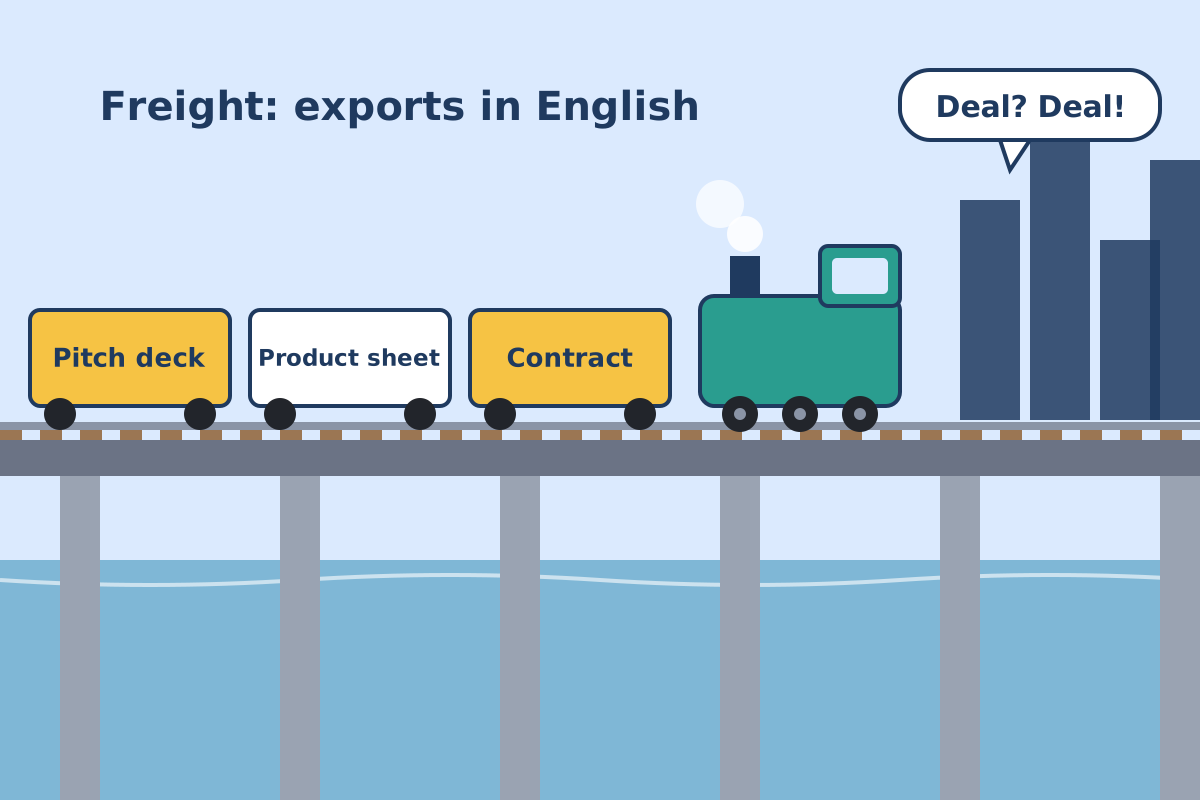
Ukrainian business has kept trading through very difficult years, and much of it trades in English. Clients on this platform tend to be small and medium-sized firms that cannot justify an in-house translator and prefer to work with one trusted freelancer:
- Software and IT service companies that write documentation, case studies and proposals in Ukrainian first and need polished English for clients in the UK, the US and Western Europe.
- Agricultural and food exporters with specifications, certificates of conformity, contracts and packaging texts.
- Manufacturers and engineering firms taking part in internationally funded projects, where bids, reports and technical descriptions usually have to be submitted in English.
- Online sellers on international marketplaces: makers of ceramics, clothing, toys and cosmetics who need product listings, size charts and customer-service templates that sound natural to a buyer in Ohio or Leeds.
- Start-ups preparing pitch decks, grant applications and websites for investors and accelerators.
These clients rarely go to a translation marketplace first. They ask other founders for a recommendation, search online in Ukrainian (“переклад на англійську”), or look on Ukrainian freelance platforms such as Freelancehunt. A freelance Ukrainian to English translator whose profile explains subject areas in Ukrainian and shows samples in English wins far more of them than one who sends a CV listing CAT tools.
Platform 4: books, films and voices
Interest in Ukrainian culture abroad has grown, and with it the demand for literary, audiovisual and editorial translation into English. The Ukrainian Book Institute runs the Translate Ukraine programme, which compensates part of the costs that foreign publishers incur to translate and publish Ukrainian books, translation fees included. Only publishers can apply, so the practical move for a translator is to bring a publisher a well-chosen book and a strong sample, and let the publisher make the application.
Beyond books there are documentaries that need English subtitles, museums and galleries preparing exhibition texts for touring shows, NGOs publishing reports and newsletters for international donors, and journalists who need interviews transcribed and translated quickly. Many of these clients are small teams with tight budgets and strict deadlines; they value a translator who can also suggest a better English headline.
Platform 5: students, scientists and professionals
Ukrainian students apply to universities in the UK, Ireland, Canada and the US; Ukrainian scientists apply for fellowships and publish in English-language journals; doctors, nurses, engineers and teachers ask professional bodies abroad to recognise their training. All of them need diplomas, academic transcripts, course descriptions and reference letters in English, often in a hurry because an application window is closing.
Course descriptions are the underrated job here: a single degree can come with dozens of pages listing modules and hours. Clients do not always know they will need them, so mention them on your profile and you will often win the whole package, not just the diploma.
The names on the ticket: language traps of this direction
A client who has hired an amateur once usually learns the hard way that Ukrainian into English is not a word-swapping exercise. These are the issues that most clearly justify paying a professional.
Transliteration and the passport
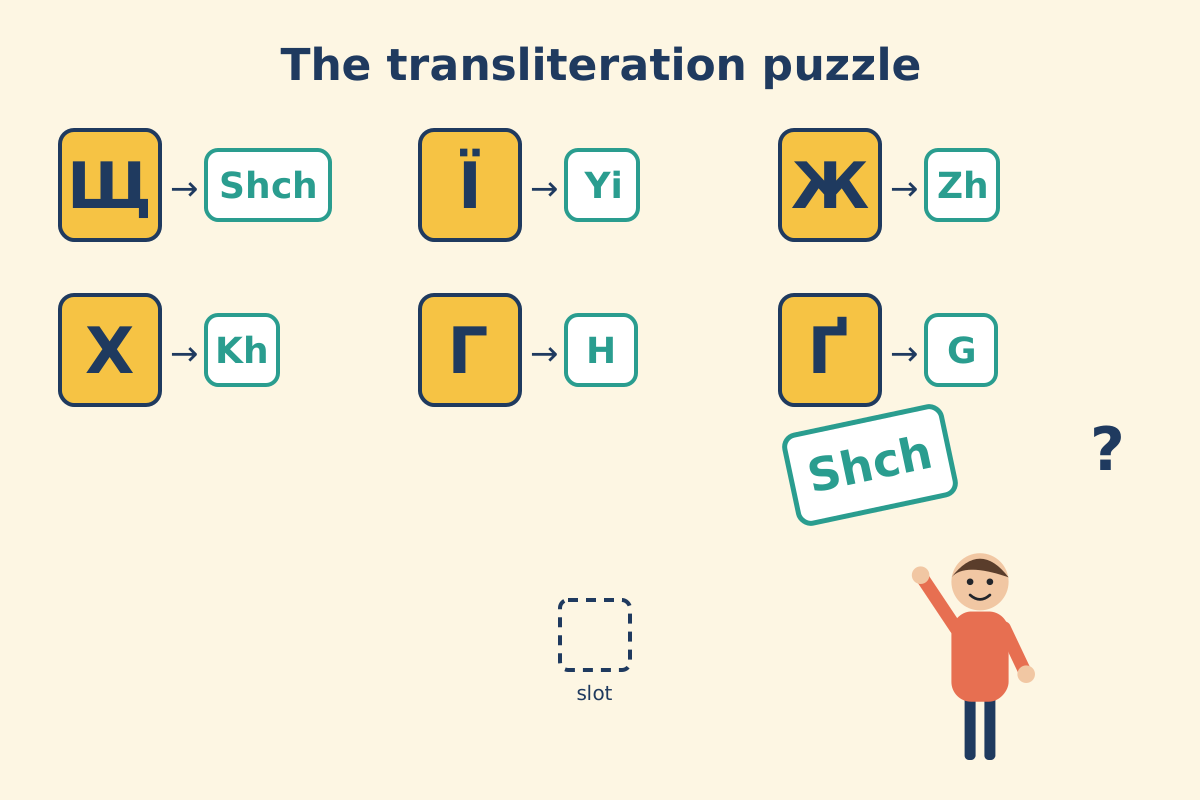
Ukraine has an official national system for writing Ukrainian in Latin letters, adopted by a Cabinet of Ministers resolution in 2010 (an online converter is published here). It gives “Kharkiv”, “Zaporizhzhia” and “Shcherbak”. But for a person’s name, the rule that beats every system is simple: copy the spelling from the client’s international passport, even if it follows an older convention. A birth certificate that says “Oleksandr” while the passport says “Aleksandr” will raise questions, so ask for a passport scan before starting and add a translator’s note when the spellings differ. For place names, follow current usage: “Kyiv”, not the older form, is now standard in major English-language style guides.
A language without articles
Ukrainian has no “a” or “the”, while English cannot live without them. It also builds long sentences out of participles and stacked nouns, especially in official and academic writing. A literal rendering of a university regulation can produce a 70-word sentence with five “of”s. Splitting, reordering and choosing the right article are the invisible work that makes the English readable.
Bureaucratic vocabulary with no twin
“ФОП” (a sole-trader status), the “ЄДРПОУ” company code, the individual taxpayer number, “громада” (the territorial community, the basic unit of local government after the decentralisation reform), “область” (oblast or region) and “по батькові” (the patronymic) have no exact counterparts in British or American administration. A common approach is to keep a transliterated term the first time, add a short explanation in brackets, and then stay consistent. Dates written as 05.03.2024 mean 5 March, not May 3, so spelling out the month avoids a classic mistake in American files.
A direct line for the freelance Ukrainian to English translator: your Traductores Nativos profile
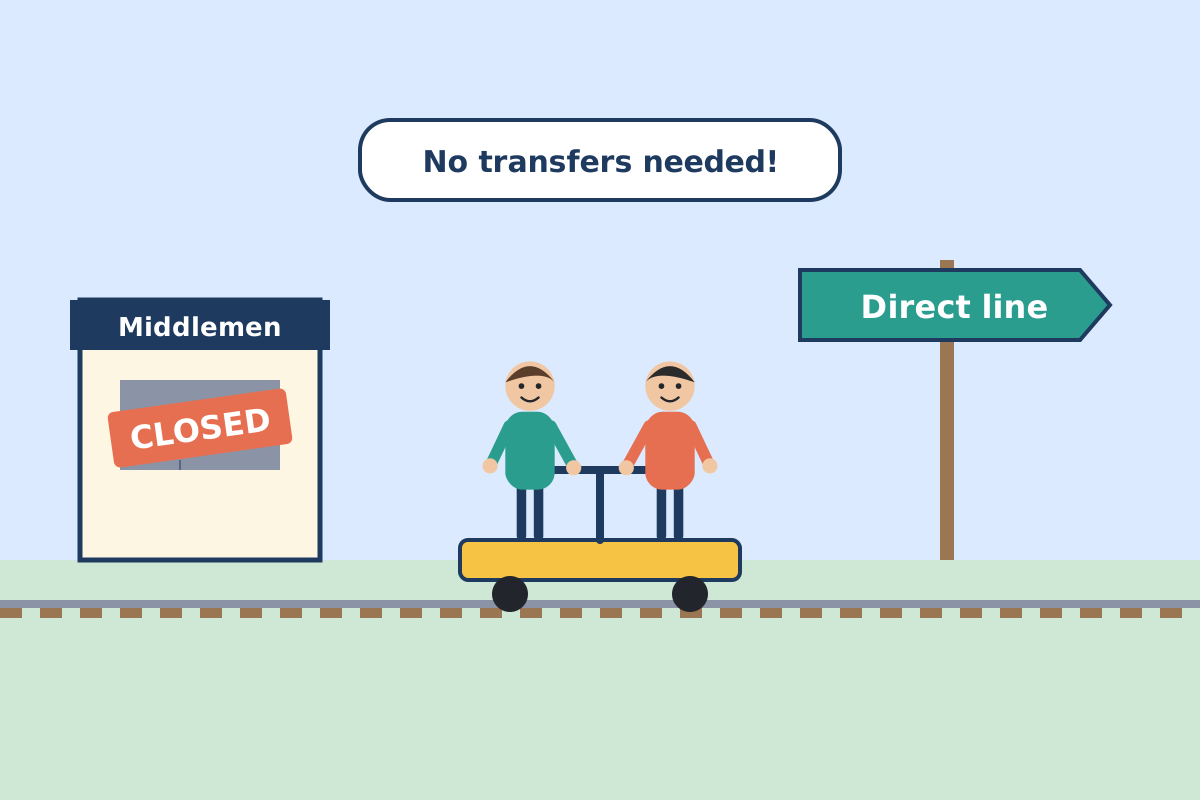
Most passengers on platforms 1, 2 and 5 are private individuals. They are not used to buying translations, they are often nervous about sending identity documents to a stranger, and they would rather speak to the person who will actually do the work. Traductores Nativos was built for that situation: the client chooses a native translator, writes to them with no intermediary, reads the reviews other clients left in public, and may settle the bill through a guarantee service.
Some pair-specific ideas for your profile:
- Write the introduction in Ukrainian and English. The person searching is usually Ukrainian, while the person reading the result is often an English-speaking official or employer.
- List destinations, not just documents. “Certificates for the UK Home Office, IRCC, USCIS and Irish employers” tells a family immediately that you know where their file is going.
- State your transliteration policy. One sentence such as “names are spelt as in your passport” answers a question most clients worry about.
- Be clear about Russian-language and older documents. If you handle Soviet-era certificates, say so; if you do not, say that too.
- Mention the practical extras: notarisation in Ukraine, apostille guidance, scans accepted from phones, delivery as a signed PDF.
- Collect reviews from the families you help. Public reviews matter more on this platform than any diploma, because the next client is usually a friend of the last one.
Want your own profile? Get in touch through our contact page or email info@traductoresnativos.com, and tell us which documents, subject areas and destination countries you cover.
Other stations worth a stop
Directories and associations help clients check that a freelance Ukrainian to English translator is who they claim to be:
- The American Translators Association offers a certification exam in the Ukrainian into English direction, which carries weight with US clients and law firms.
- ITI and CIOL in the UK, provincial associations in Canada and NAATI in Australia all run public directories that clients and lawyers consult.
- The Ukrainian Translators Association brings together professionals inside Ukraine and is useful for meeting notaries’ regular translators and colleagues who need an into-English partner.
- Diaspora organisations and community groups in the UK, Canada and the US, as well as the many Telegram channels and Facebook groups where Ukrainians abroad share practical advice. Answer questions helpfully, never spam, and people will remember your name when they need a certified translation.
Immigration solicitors, family lawyers, recruitment agencies placing Ukrainian workers and university admissions offices are also worth a polite introduction: they meet the same documents every week and are happy to have a reliable name to recommend.
Talking about money without guessing
Rates vary a lot depending on where you live, who the client is and how the translation must be certified, so there is no single benchmark. A few habits work well for a freelance Ukrainian to English translator. Quote certificates per document, since the client thinks in documents rather than words. Separate the translation fee from extras such as notarisation or courier costs. Offer a family package when one household sends five certificates at once. And for business clients, quote per project with a clear scope, because a pitch deck needs a very different kind of effort from a price list. Compare with what colleagues on other into-English routes do, but price for your own market.
On tools, briefly: term bases pay off with recurring business texts, while machine output stumbles over handwriting, stamps and abbreviations, so every line still needs your eyes.
A twelve-week timetable
- Weeks 1–2: decide on your platforms. Pick two or three of the five above and the destination countries you know best.
- Weeks 3–4: build templates: certification statements for the UK, US and Canada, a glossary of administrative terms, and a translator’s note for differing name spellings.
- Weeks 5–6: publish or update your Traductores Nativos profile in both languages and list your document types and destinations.
- Weeks 7–8: join one association and its directory; contact five immigration or family law firms in your target country.
- Weeks 9–10: prepare two English samples for business clients (a product page and a short case study) and send them to Ukrainian companies in your field.
- Weeks 11–12: ask every satisfied client for a public review, then look at which platform brought the best work and spend more time there.
If you also translate from Spanish, the Spanish to English guide in this series covers that market from a different angle.
Questions from the platform
A client sends a Soviet-era certificate written in Russian. Should I accept it?
Only if your Russian is strong enough to certify the translation with confidence. Many receiving authorities do not care which language the original is in, but they do expect the translator’s statement to be true. If you accept, mention the source language correctly in your certification.
The passport and the birth certificate spell the name differently. What do I do?
Use the passport spelling in the translation and add a short translator’s note explaining the variant, if the client agrees. Never “correct” a name to your preferred transliteration system on your own initiative.
Do I translate the Ukrainian notary’s wording and the stamps?
For a complete translation, yes: stamps, seals, handwritten notes and certification text are part of the document. Describe illegible parts as “[illegible]” rather than guessing.
Can a client use a screenshot from the Diia app as the source document?
That depends entirely on the authority that will receive the translation. Translate what you are given, describe the format honestly in your note, and suggest the client check whether a paper extract or official copy is required.
Is there demand outside personal documents?
Yes. Companies, publishers, NGOs, universities and media teams all commission Ukrainian into English work, and they tend to become regular clients once they find someone reliable.
Conclusion
The Ukrainian to English line has five busy platforms: families settling in English-speaking countries, paperwork that stays in Ukraine, companies selling abroad, culture and media, and students and professionals. A freelance Ukrainian to English translator who knows the rules at each destination, handles names with care and makes it easy for clients to write directly will rarely wait long for the next passenger. Make your profile clear, answer quickly, and let reviews do the rest.
Related articles
About the author: Viorel Tiple founded Traductores Nativos, a search engine that puts people in direct touch with native translators, with no middlemen involved.