Tendencias en agencias de traducción y tecnología IA 2026

Translation agencies: Industry overview 2025 and trends 2026

In 2025, ethical positions in professional translation revolve around four fundamental axes: fidelity to the text, respect for the people and cultures involved, confidentiality of data, and responsible use of AI in translation processes. This panorama marks the path for what translation agencies and independent professionals will face in 2026.

Ethical and deontological principles in the sector


The foundation of professional translation continues to rest on classic principles, though adapted to modern demands:

  • Fidelity and Accuracy: There is a strong emphasis on maintaining the meaning, intent, and nuances of the original text, avoiding additions, omissions, or manipulations unless explicitly agreed upon with the client.
  • Confidentiality: Translation agencies are strengthening their obligation to protect sensitive data (medical, legal, financial) and implementing clear information management protocols.
  • Impartiality and Neutrality: Professional translators must avoid introducing personal biases, conflicts of interest, or unjustified ideological modifications.
  • Professional Dimension: Adherence to codes of ethics from professional associations (e.g., AIIC, ATA) that regulate honesty and transparency is underscored. Ethics also involve informing the client about limitations, text ambiguities, and the consequences of specific terminological decisions. To delve deeper into the theoretical foundations of this discipline, further information on translation studies and its academic evolution is available.

Culture, Ideology, and Power


The idea that translating also means representing cultures and social groups is gaining weight, requiring the avoidance of stereotypes, discrimination, and the erasure of minorities. Academic debates highlight how ideology and power dynamics influence translation decisions, and translation agencies are proposing a critical ethical stance, conscious of these biases.

In sensitive documents (legal, medical, or institutional), a special responsibility is emphasized: errors can have serious legal or clinical consequences. Dilemmas such as offensive language are discussed, always recommending dialogue with the client before softening any content.
Tendencias en agencias de traducción y tecnología IA 2026

Ethics and Artificial Intelligence in 2025


With the expansion of AI, translation agencies are reinforcing requirements for data privacy and human oversight, especially in the legal and healthcare sectors. The following are established as ethical obligations:

  • Mitigation of biases in automated systems.
  • Full transparency regarding whether a translation was generated or assisted by machines.
  • Critical review of AI outputs.

How Demand in Translation Agencies Will Change in 2026


The demand for professional translators in 2026 is not disappearing but rather transforming: it is decreasing for routine and literal tasks and growing for highly complex, specialized services heavily supported by AI.

General Demand Trends

The global language services market continues to grow, driven by globalization and e-commerce. Although machine translation handles basic work, it generates more total volume, which increases the need for qualified professionals within translation agencies.

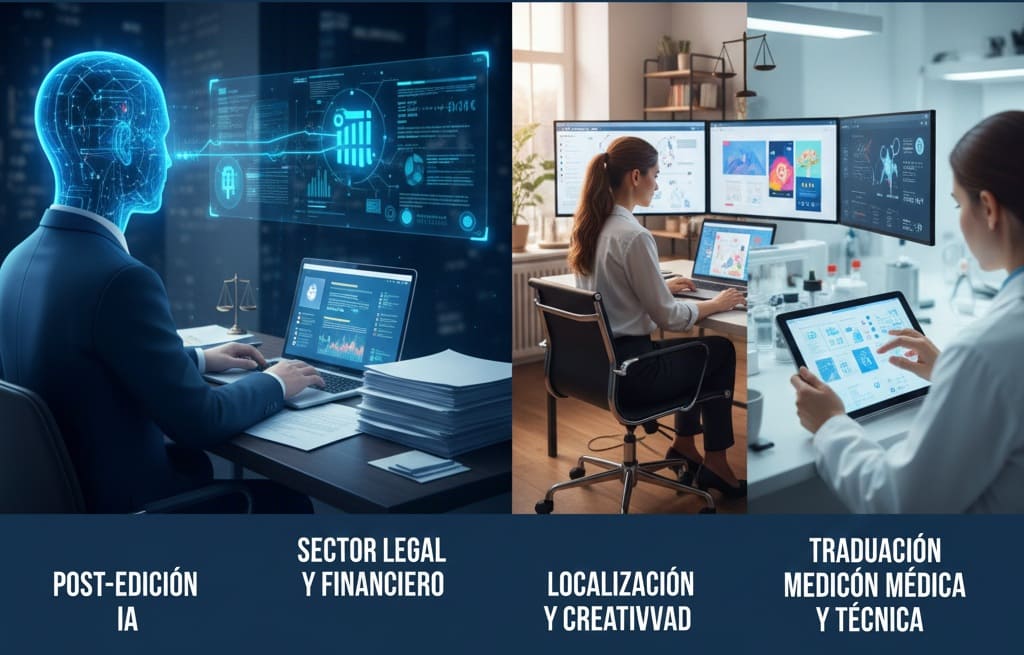
New Roles and Tasks: The Era of AI Post-editing

  • Consolidation of AI Post-editing (MTPE): Many translators are shifting from translating from scratch to reviewing and refining drafts produced by AI systems.
  • High Value-Added: There is an increased focus on content localization, transcreation, linguistic consultancy, and multilingual quality control for digital brands.
  • Growth Areas: Strong demand in legal, medical, technical, and financial fields. Localization of software, video games, apps, and multimedia content (subtitles, dubbing) adapted culturally is also rising.
  • Remote Interpreting: This is consolidating as a stable modality, requiring interpreters capable of managing hybrid events and online platforms.

Competitive Professional Profile

Translators with subject-matter specialization and technological competencies (CAT, MT, LLM) are more highly valued. Small studios and flexible freelancers offering personalized service and high quality benefit over pure volume models based solely on AI.
Translation Agencies: 2025 Industry Summary & 2026 Trends

How AI Post-editing Will Affect Rates in 2026


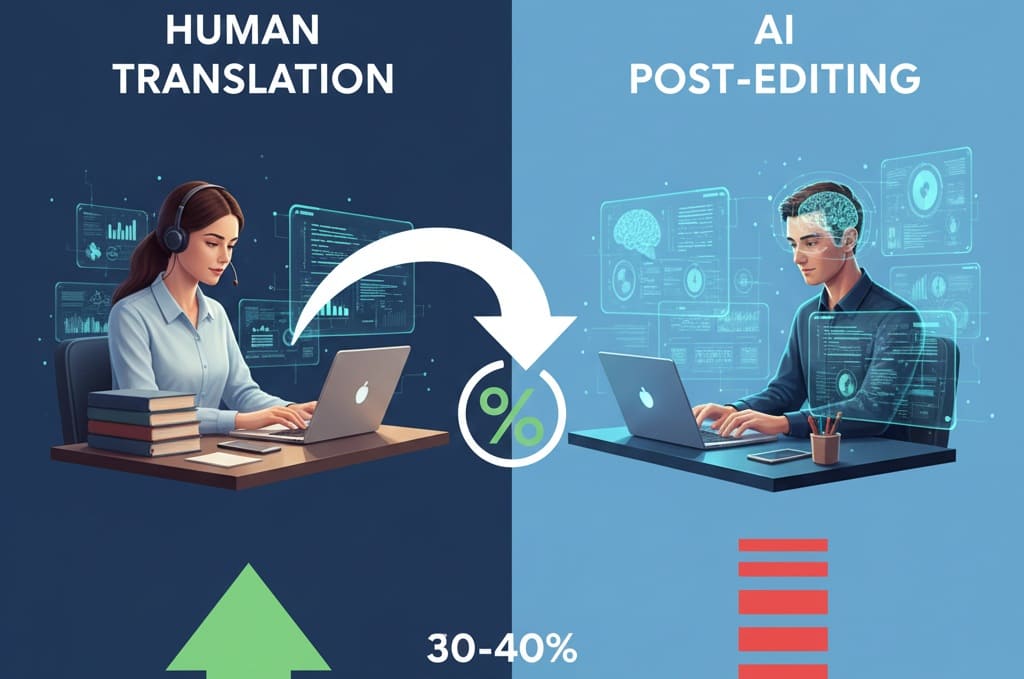
AI Post-editing typically reduces the rate per word, but not linearly. Many offers range between 50% and 70% of a “normal” rate.

  • Typical Levels: 2025 reports indicate ranges of $0.05–$0.15 USD per word for MTPE, compared to $0.15–$0.30 USD for general human translation.
  • Downward Factors: A logic of “savings” leads translation agencies to request discounts of 30–40% on repetitive or low-criticality texts.
  • Value Factors: For complex technical, legal, or marketing content, post-editing effort nears that of translating from scratch, justifying rates of 70–80% of human translation.
  • Global Effect: Hourly income will depend on actual productivity. Hybrid models are consolidating as a way to balance sustainable rates with market price expectations.

Key Sectors and the Financial Sector in 2026


High-responsibility sectors (legal, medical, financial) and technology will be the primary employers of human translators.

Translation in Fintech and Financial Services

In 2026, the financial sector requires professional translation for:

  • Regulatory Compliance: KYC/AML policies, prospectuses, and reports that must match exactly across languages to avoid audit risks and sanctions.
  • Digital Interfaces: Apps, websites, and user onboarding where clarity directly impacts trust and adoption.
  • Quality Requirements: Bilingual terminological precision and protection of financial data under strict confidentiality agreements.

Translation agencies will integrate localization not as an auxiliary service, but as a formal part of the internal control systems of financial firms, especially in emerging markets in LATAM, MENA, and Asia.


Registros similares

Leave a Reply

Your email address will not be published. Required fields are marked *